Chapter 5
The Kuranda Triangle

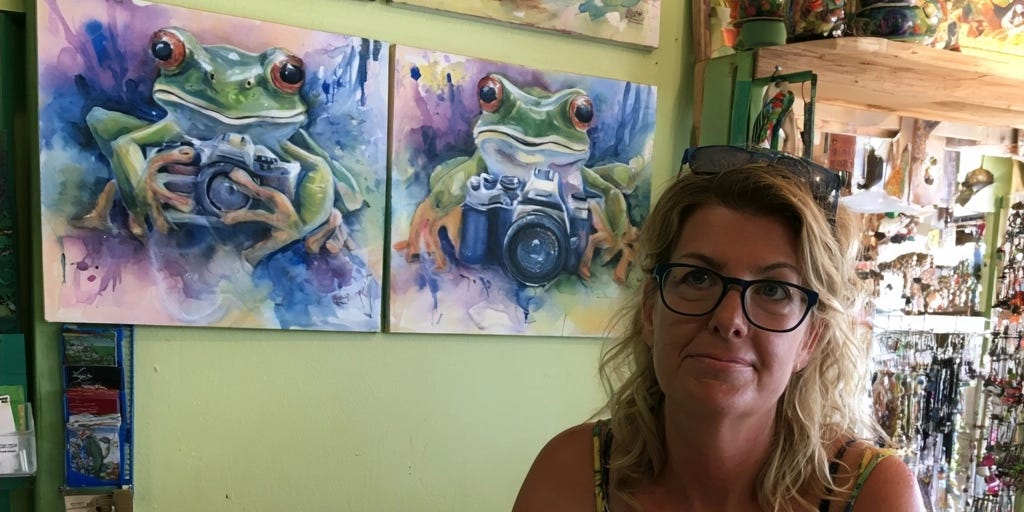
In the morning when we arrived back in Kuranda, just about the time when you have start paying for parking, and there were plenty of parking spaces everywhere. The shop was still closed. “Shall we go somewhere for a coffee,” my husband asked half-heartedly. It was clear that we were not going to charge onto the shop owner while he was still dragging the paintings outside and hanging them in front, and certainly not when he was using a ladder.
We sat down in the first cafe we found open, not far from the shop but far away enough to feel that the place was in our eyesight. It wasn’t that we were constantly watching what was going on in there, but it gave a kind of feeling that we had the power to decide when was the right time for us to go and approach him with the question we wanted an answer to, “Where are they?” and not give him any chance to evade. He’d have to answer. Once again the feeling that they were still there, inside the shop, came back to me. As the thoughts and conversations rose to the point of returning to the shop, we were already on our second coffee. It was unusual for us to drink two cups, but the shop still hadn’t opened, and then when it would be open we’d still have to wait for him to finish hanging the paintings at the front.
Even after we finished our second cup of coffee, the shop did not open. We got up to take a walk among the stalls and ask here and there if anyone had seen my husband’s parents. There was no hope that anyone would have noticed them among all the hundreds of people who walked around the place every day. Here and there we stopped and asked, receiving a strange look in reply to our questions. It was clear that we only walked around the block just to wait and see when the shop was finally open for the public.
On the fourth go-around, as we approached from a distance, we could already see all the paintings hanging on the front again. We even felt a kind of joy in our hearts. At last! We also no longer felt the anger that had built up inside us earlier. Without hesitation we rushed inside. Once again, the darkness of the place created the feeling that something was hiding in some dark corner somewhere. We wasted no time and went straight to the counter.
The man wasn’t there. Instead, there was a woman sitting on the edge of a chair doing a crossword puzzle. “Who the hell does crosswords in this day and time?” I said in Dutch to my husband, it looked so anachronistic. We stood in front of the counter, and it was clear that she would not be able to answer our question. So then we started asking questions about the artists and the works on the walls, and she explained us. “Generally, we only display works related to nature here. Plants and animals. It is up to the artist to choose what they like to paint.”
For some reason, this text was expected, for what else could be said about the paintings that depicted a cockatoo, an emu, a possum, and Ulysses and other butterflies here and there, or a piece of wood with a flower, or a group of frogs with cameras in their hands? I couldn’t help but laugh and just scoff about the fact that they were very poorly drawn technically, like a child’s attempt to draw without knowing how to draw a frog, even though they see them every day.
She caught me laughing while I was looking at the frog paintings that were practically hanging behind her. My gaze returned to her as she said, “Yes, these are especially lovely paintings that say so much, and many people really love them. We sell quite a few frog paintings.” I couldn’t contain myself and it just poured out of me. “Without cameras, or only with?” She looked at me with the understanding that I was not one of her clients and especially not for the frogs who hung comfortably behind her, so as to easily reach out, putting it in a bag, taking the money handing it over, and putting a fresh one in the empty spot. “Art is not what you think it is, it’s a metaphor,” she told me and continued, “People like to buy something that reminds them of their trip to North Queensland and Australia.” I could see her point, after all she saw me as a tourist and suddenly I could see myself just as she did. I understood the difference.
“Why are you here?” she asked me as my husband by then had turned to the other side of the shop and created distance. “It’s good that you ask. Yesterday we went to your shop with my husband’s parents who are visiting Australia, and they never left this shop after they went in. We sat on a bench outside the whole time,” I said.
She looked at me more understandingly and asked if we had gone to the police. “The back door is locked, they couldn’t have gotten out through it,” she added as if she had read my thoughts, just like the day before when I talked about it with her colleague. “If you’ve already been at the police station yesterday, maybe they found them in the meantime,” she added. I thanked her and looked for my husband so I could go again to the police station to find out.
At the police station the officer that helped us the previous day was there, so we didn’t have to explain why we came, except that he said, “So you didn’t find them either. For some reason, people seem to disappear in this shop.”